

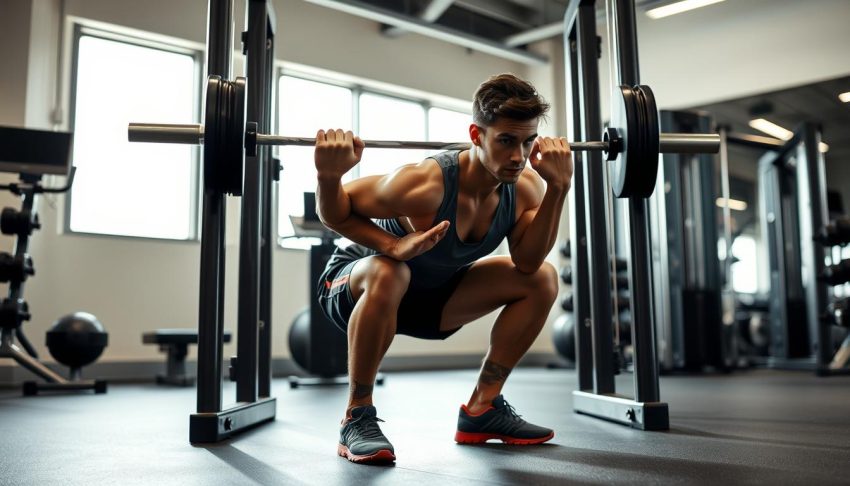
The Smith machine is a versatile piece of equipment that has garnered both praise and criticism among fitness enthusiasts for its role in leg training.
When performed correctly, squats on the Smith machine can be beneficial for both beginners and experienced lifters, offering a safe and effective way to target specific muscle groups.
This guide will walk you through the proper form, variations, and programming for maximum gains using the Smith machine, helping you to enhance your leg training routine.
Key Takeaways
- Learn how to perform squats on the Smith machine safely and effectively.
- Discover variations of squats to target different muscle groups.
- Understand how to program Smith machine squats for maximum gains.
- Enhance your leg training routine with the Smith machine.
- Benefit from the safety features of the Smith machine for solo training.
Understanding the Smith Machine
A Smith machine is a type of weight training equipment that restricts the movement of the barbell to a fixed path, either vertically or at an angle. This characteristic makes it distinct from free weight equipment like squat racks, where the lifter must control the weight in multiple planes of motion.
Defining the Smith Machine
The Smith machine is essentially a barbell fixed within steel rails, allowing only vertical or near-vertical movement. This design provides a guided bar path, which can be particularly beneficial for beginners or those looking to isolate specific muscle groups without the need to stabilize the weight.
Fixed Bar Path vs. Free Weight Movement
One of the primary differences between the Smith machine and free weights is the path of movement. Free weights allow for a natural range of motion in multiple directions, whereas the Smith machine constrains the bar to a fixed path. This can affect muscle recruitment and movement mechanics, as the lifter does not need to balance the weight laterally.
Types of Smith Machines: Angled vs. Straight
Smith machines come in two main types: angled and straight. Angled Smith machines, which are typically inclined between 7-12 degrees, allow for a more natural squat bar path. When using an angled Smith machine, it’s essential to position yourself so that your body is facing away from the direction of the angle, ensuring optimal squat mechanics.
By understanding the mechanics and types of Smith machines, lifters can better utilize this equipment to enhance their strength training routines.
Benefits of Smith Machine Squats
Smith machine squats provide a unique combination of safety, control, and effectiveness that can enhance your leg day routine. This exercise is particularly beneficial for those looking to target specific muscle groups while minimizing the risk of injury.

Safety Features and Solo Training
One of the primary advantages of the Smith machine is its safety features, which allow for solo training without the need for a spotter. The built-in safety catches provide a secure environment for lifting, enabling you to push yourself to your limits without risking serious injury. This is particularly beneficial for beginners who are new to weight training or for experienced lifters looking to maximize their squat performance.
Muscle Isolation and Targeting
The Smith machine allows for precise muscle targeting by adjusting foot placement. For instance, placing your feet further forward under the bar will activate your quads and glutes more, while positioning your feet under the bar will emphasize the quads. This level of control enables you to tailor your workout to your specific needs, ensuring a more effective leg day routine.
Progressive Overload Potential
The fixed bar path of the Smith machine enables lifters to focus on progressive overload without worrying about stabilization. This means you can lift heavier weights and make consistent gains in strength and muscle mass. The stability provided by the machine is particularly advantageous for those looking to challenge themselves beyond their current limits.
Rehabilitation and Injury Prevention
Smith machine squats are also beneficial for rehabilitation and injury prevention due to their controlled movement pattern. The machine guides the bar through a fixed path, reducing the risk of improper form and associated injuries. This makes it an excellent option for those recovering from injuries or looking to prevent them in the first place.
- Enhanced safety features for solo training
- Precise muscle targeting through adjustable foot placement
- Potential for progressive overload and increased strength
- Beneficial for rehabilitation and injury prevention
Smith Machine vs. Free Weight Squats
Understanding the differences between Smith machine squats and free weight squats is crucial for optimizing your leg day routine. Both methods have their place in a comprehensive training program, but they serve different purposes and offer unique benefits.
Key Differences in Mechanics
The primary difference between Smith machine squats and free weight squats lies in their mechanics. The Smith machine guides the bar along a fixed path, reducing the need for stabilizer muscles. In contrast, free weight squats require more control and engagement from the core and stabilizer muscles to maintain proper form. Additionally, foot placement differs between the two; Smith machine squats typically require feet to be positioned slightly forward of the bar, whereas free weight squats allow for a more natural stance.
Muscle Activation Comparison
Research indicates that free weight squats engage stabilizer muscles approximately 43% more than Smith machine squats. This increased activation is due to the need to balance and control the weight throughout the movement. While free weight squats require more overall muscle engagement, Smith machine squats allow for greater focus on the primary movers, such as the quadriceps, glutes, and hamstrings.
When to Choose Each Type
The choice between Smith machine squats and free weight squats depends on your training goals and experience level. Smith machine squats are ideal for isolation, safety, and when training alone, as they provide additional support and reduce the risk of injury. On the other hand, free weight squats are better suited for developing functional strength and core stability. Incorporating both into your training program can provide a well-rounded approach to leg development.
By understanding the strengths and limitations of each method, you can make informed decisions about your training and maximize your gains.
Muscles Worked During Smith Machine Squats
The Smith machine squat is a compound exercise that targets several key muscle groups in the lower body. This exercise is particularly effective for building strength and muscle mass in the legs.
Primary Muscles: Quads and Glutes
The primary movers during Smith machine squats are the quadriceps and gluteal muscles. The quadriceps, comprising four heads (rectus femoris, vastus lateralis, vastus medialis, and vastus intermedius), are responsible for knee extension. The gluteal muscles, including the gluteus maximus, medius, and minimus, contribute to hip extension and external rotation.
Quadriceps Activation: The quadriceps are more activated during Smith machine squats compared to free weight squats, primarily due to the fixed bar path which allows for a more controlled movement.
Secondary Muscles: Hamstrings, Calves, and Core
In addition to the primary movers, several secondary muscles are engaged to support the movement. These include the hamstrings, which assist in hip extension and knee flexion, the calf muscles, which help control ankle movement, and the core muscles, including the abdominals and lower back, which provide stability throughout the exercise.
- Hamstrings: Assist in controlling the descent and stabilizing the knee joint.
- Calves: Help maintain proper ankle positioning and contribute to overall lower leg stability.
- Core Muscles: Essential for maintaining posture and stability throughout the squat.
How Foot Placement Affects Muscle Engagement
Foot placement during Smith machine squats significantly affects the muscle groups engaged. A wider stance tends to target the glutes and hip adductors more, while a narrower stance emphasizes the quadriceps. Adjusting foot placement allows you to customize the exercise to focus on specific muscle groups.

By understanding how different foot placements and depths affect muscle activation, you can tailor your Smith machine squat routine to achieve your specific training goals, whether it’s to enhance quadriceps development or to build stronger glutes.
Setting Up the Smith Machine Properly
Before you start squatting on the Smith machine, ensure it’s set up properly for your safety and effectiveness. Proper setup involves several key steps that will help you maximize your workout while minimizing the risk of injury.
Bar Height and Safety Catches
Adjust the Smith machine bar to shoulder height. This allows for comfortable unracking without straining or coming up on tiptoes. The bar should rest on your traps and rear deltoids when standing up, not on the back of your neck. Additionally, set the safety catches to slightly below your range of motion. This ensures that if you fail a rep, the safety catches will prevent the bar from going any further, providing a safe environment for your workout.
Weight Selection for Beginners
For beginners, it’s crucial to select an appropriate weight. Note that the Smith machine bar typically weighs less (15-25 lbs) than a standard barbell (45 lbs). Start with a weight that allows you to maintain proper form, and gradually increase it as you build strength.
Creating a Stable Foundation
Before unracking the bar, ensure you have a stable foundation with proper foot positioning and body alignment. This involves standing with your feet shoulder-width apart and your body aligned with the bar. Testing the setup with an empty bar before adding weight can help ensure comfort and proper mechanics.
By following these steps, you can ensure that your Smith machine is set up correctly, providing a safe and effective environment for your squat workouts.
Proper Smith Machine Squat Form
Proper form is the cornerstone of effective Smith machine squats, ensuring you target the right muscles safely. To achieve this, it’s crucial to understand the correct technique from the starting position to the completion of the squat.
Starting Position and Setup
To begin, approach the Smith machine bar, turning so you face outward. Rest the bar on your upper traps, not your neck. Take hold of the bar with your hands placed just outside your shoulders. Walk your feet one step forward, positioning them slightly wider than shoulder-width apart. This stance is crucial for maintaining balance throughout the exercise.
Once you’re in position, twist the bar to unlock it from the machine’s safety catches. Take a deep breath in, bracing your core as you do so. This initial breath helps stabilize your body for the movement ahead.

The Descent: Technique and Depth
Initiate the squat by pushing your hips back, keeping your chest up and your knees in line with your toes. As you descend, ensure your knees track over your toes, maintaining alignment to avoid undue stress on your joints. Continue lowering yourself until your thighs are at least parallel to the floor. For optimal muscle engagement, aim to go slightly below parallel if your flexibility allows.
The Ascent: Driving Through Your Heels
Pause briefly at the bottom of the squat, then reverse the movement. To ascend, push through your heels, extending your legs and maintaining an upright torso. Keep your core engaged throughout this phase to support your lower back. By driving through your heels, you maximize the engagement of your leg muscles, particularly the quadriceps and glutes.
Breathing and Bracing
Proper breathing technique is vital during Smith machine squats. Inhale during the descent, filling your lungs fully to help brace your core. As you begin the ascent, exhale, maintaining core tension throughout the movement. This breathing pattern supports your spine and enhances overall stability.
By focusing on these elements of proper form, you can optimize your Smith machine squat technique, ensuring a safe and effective workout that targets the intended muscles.
7 Common Smith Machine Squat Mistakes to Avoid
Many lifters make critical mistakes when performing Smith machine squats, which can lead to suboptimal results and potential harm. Being aware of these common errors can help you optimize your workout and achieve better gains.
Incorrect Foot Placement
One of the most common mistakes is incorrect foot placement. Placing your feet too far forward or directly under the bar can lead to poor mechanics and strain on your joints. To avoid this, experiment with different foot positions to find what works best for you, keeping in mind that your feet should be forward when using the Smith machine.
Rounding the Lower Back
Rounding your lower back, also known as “butt wink,” during Smith machine squats can put unnecessary stress on your spine. Maintaining proper spinal alignment is crucial. Engage your core and keep your back straight throughout the movement to avoid this common pitfall.
Knees Caving Inward
Allowing your knees to cave inward during the squat can lead to knee issues and reduce the effectiveness of the exercise. To prevent this, focus on pushing your knees outward in line with your toes, ensuring proper tracking and minimizing strain on your knee joints.
Leaning Too Far Forward
Leaning too far forward during squats shifts stress to your lower back and reduces the engagement of your quadriceps. Maintaining an upright torso is essential. Keep your chest up and your back straight to ensure you’re targeting the right muscles.
Insufficient Range of Motion
Performing half squats or having an insufficient range of motion reduces muscle development and can lead to imbalances. To maximize gains, focus on squatting to parallel or deeper, using good form to guide your movement.
Rising on Toes
Rising onto your toes during the squat can stress your knees and alter your biomechanics. Keeping your entire foot planted throughout the movement is crucial for maintaining proper form and minimizing the risk of injury.
Improper Bar Path
Using an improper bar path can lead to inefficient muscle recruitment and increased risk of injury. Ensure that the bar moves in a vertical plane, aligned with your body’s natural movement, to get the most out of your Smith machine squats.
By being mindful of these common mistakes and taking steps to correct them, you can optimize your squat workouts and achieve better results.
Smith Machine Squat Exercises for Beginners

Beginners can greatly benefit from using the Smith machine for squats due to its stability and safety features. This equipment allows individuals to focus on the squat movement without worrying about balancing the weight, making it an ideal tool for those new to weight training.
Basic Smith Machine Squat
The basic Smith machine squat is a fundamental exercise that helps beginners build confidence and develop muscle memory. To perform this exercise, start by setting the bar to a comfortable height. Stand under the bar with your feet shoulder-width apart, then grasp the bar with your hands slightly wider than shoulder-width apart. Slowly lower your body down into a squat, keeping your back straight and your knees behind your toes. Push through your heels to return to the starting position.
Beginners should start with light weights or even just the bar to master the technique before adding resistance. Proper breathing and bracing are crucial; take a deep breath in as you lower yourself and exhale as you push back up.
Box Squats for Form Development
Box squats are a valuable variation for beginners, helping to develop proper depth and form awareness. To perform box squats on the Smith machine, set a box or bench behind you to a height that allows your thighs to be parallel to the ground when seated. Stand under the bar, then lower yourself down until you lightly touch the box, and push back up to the starting position. This exercise helps in understanding the full range of motion required for a squat.
For beginners, it’s recommended to start with higher rep ranges (12-15 reps) and gradually increase the weight as they become more comfortable with the exercise. Incorporating Smith machine squats into a training routine 2-3 times a week can help in building strength and confidence.
Intermediate Smith Machine Squat Variations

Once you’ve mastered the basic Smith machine squat, it’s time to take your lower body training to the next level with intermediate variations. These exercises are designed to challenge your muscles in new ways, promoting continued growth and strength.
Narrowing Your Stance: Close-Stance Smith Machine Squats
Close-stance Smith machine squats involve placing your feet closer together than shoulder-width apart. This stance increases quadriceps activation and changes the mechanics of the movement, making it an effective variation for targeting the quads.
The narrower foot position reduces the involvement of the glutes and hamstrings, allowing you to focus on the quadriceps. To perform close-stance Smith machine squats, stand with your feet about 6-8 inches apart, toes pointing forward or slightly outward.
Widening Your Stance: Wide-Stance Smith Machine Squats
Wide-stance Smith machine squats are performed with your feet placed wider than shoulder-width apart. This variation shifts the emphasis to the glutes, adductors, and outer quad muscles, providing a comprehensive lower body workout.
By widening your stance, you increase the range of motion and activate the muscles of the inner thigh and glutes more intensely. Stand with your feet about 1.5 to 2 times shoulder-width apart, with your toes pointing outward.
Front Squats on the Smith Machine
Smith machine front squats are an excellent variation for targeting the quadriceps. To perform this exercise, place the bar across the front of your shoulders, resting it on your anterior deltoids, and hold it in place with your elbows high.
This variation increases quadriceps engagement due to the anterior loading of the bar. Ensure that your elbows remain high throughout the movement to maintain proper form and maximize the effectiveness of the exercise.
These intermediate Smith machine squat variations offer a range of benefits, from increased quadriceps activation to enhanced glute and adductor involvement. By incorporating these exercises into your routine, you can create a well-rounded lower body development program using just the Smith machine.
Advanced Smith Machine Squat Exercises

To challenge your legs further, consider integrating more complex Smith machine squat exercises into your routine. These advanced variations are designed to push your muscles beyond their current capacity, promoting significant strength and muscle mass gains.
Smith Machine Split Squats
Smith machine split squats are a unilateral exercise that targets the quadriceps and glutes of the working leg. By using the Smith machine, you gain instant stability, allowing you to focus on the working leg without worrying about losing balance mid-rep. This exercise is particularly effective for improving balance and symmetry between legs.
Smith Machine Sissy Squats
If you’re looking to emphasize your quadriceps, the Smith machine sissy squat is an excellent choice. Unlike traditional squats where you sit back onto your heels, sissy squats involve sinking forward onto your toes, significantly increasing the tension on your quads. This variation requires careful form to maximize its effectiveness and minimize the risk of injury.
Smith Machine Hack Squats
Smith machine hack squats are another effective variation for targeting the quadriceps. By positioning your feet and adjusting your torso angle, you can maximize the development of your quads. This exercise is particularly useful for those looking to add variety to their leg day routine and challenge their muscles from different angles.
Each of these advanced Smith machine squat exercises offers unique benefits and can be incorporated into your training program to enhance lower body development. By focusing on proper form and progressively increasing the challenge, you can achieve significant gains in strength and muscle mass.
Programming Smith Machine Squats
Effective programming of Smith machine squats is crucial for achieving your fitness goals. Whether you’re focusing on strength, hypertrophy, or endurance, a well-structured workout plan is essential.
Optimal Rep Ranges
The rep range you choose depends on your specific fitness goals. For strength, aim for 3-8 reps with a challenging weight. For hypertrophy (muscle growth), target 6-12 reps. For endurance, go for 12-15+ reps.
It’s not just about the number of reps; the load should be challenging enough that you’re close to failure (1-3 reps left in the tank).
Incorporating into Your Leg Day
Smith machine squats can be a primary movement or an accessory exercise in your leg day routine. Consider your overall leg development and choose exercises that complement the Smith machine squat.
For a well-rounded leg day, you may include other exercises like lunges, leg press, or leg extensions.
Progressive Overload Strategies
To continue making progress with Smith machine squats, employ progressive overload techniques. This can include increasing the weight, adding reps, decreasing rest periods, or increasing time under tension.
For example, you can challenge yourself by adding weight or reps over time, or by decreasing rest periods between sets.

Sample Smith Machine Squat Workouts
To get the most out of your smith machine squat exercises, it’s essential to incorporate them into a well-structured workout routine. Here are three sample workouts tailored to different experience levels and goals.
Beginner Leg Day Routine
For beginners, start with a basic smith machine squat workout that includes 3 sets of 8-12 reps. Combine this with other leg exercises like leg press and lunges to create a comprehensive leg day routine. Aim for 2-3 times per week, allowing for adequate rest and recovery.
Hypertrophy-Focused Workout
To maximize muscle growth, try a hypertrophy-focused workout that includes various smith machine squat variations. Incorporate 4 sets of 10-15 reps for exercises like wide-stance smith machine squats and smith machine front squats. Complement these with other exercises like leg extensions and leg curls.
Strength-Building Program
For a strength-building program, focus on heavy smith machine squats with lower rep ranges. Perform 4 sets of 6-8 reps, resting for 2-3 minutes between sets. Combine this with other strength-building exercises like deadlifts and lunges to create a well-rounded lower body program.
Progressive overload is key to continued development. Gradually increase the weight or reps over time to challenge your muscles and avoid plateaus. As you get stronger, you can also modify the workout by changing the rep range or adding more exercises.
Combining Smith Machine Squats with Other Exercises
To maximize lower body development, it’s essential to combine Smith machine squats with other exercises effectively. This approach allows for a more comprehensive leg workout, targeting various muscle groups and enhancing overall strength.
Complementary Free Weight Exercises
Smith machine squats can be paired with free weight exercises like barbell squats, lunges, and deadlifts to create a well-rounded lower body program. For instance, using Smith machine squats as an accessory exercise alongside your regular barbell squat can help hone in on specific muscle groups. This combination is particularly beneficial for bodybuilders who require detailed muscle development.
- Barbell squats for overall leg strength
- Lunges for targeted muscle development
- Deadlifts for comprehensive lower body engagement
Machine Exercises for Complete Leg Development
In addition to free weight exercises, machine exercises can be used in conjunction with Smith machine squats for complete leg development. The leg press, leg extension, and leg curl machines are excellent choices for targeting specific muscle groups.

Creating a Balanced Lower Body Program
To create a balanced lower body program, it’s crucial to incorporate a mix of Smith machine squats, free weight exercises, and machine exercises. This variety ensures that all major muscle groups are targeted, promoting overall lower body strength and development. For example, you can superset Smith machine squats with leg press or lunges for an efficient workout.
Sample Exercise Pairings:
- Smith machine squats superseded with leg press
- Barbell squats paired with lunges
Nutrition and Recovery for Maximizing Squat Gains
To maximize gains from Smith machine squat exercises, it’s crucial to focus on both nutrition and recovery strategies. Proper nutrition fuels your workouts and aids in muscle recovery, while effective recovery strategies help in repairing and growing your muscles.
Pre and Post-Workout Nutrition
Nutrition plays a vital role in optimizing your Smith machine squat workouts. Pre-workout nutrition should include a balanced meal with complex carbohydrates, protein, and healthy fats about 1-2 hours before your workout. This helps in providing energy and supporting muscle function.
- Consume a meal with complex carbs like whole grains, protein sources like chicken or fish, and healthy fats like nuts or avocado.
- Avoid heavy meals that can cause discomfort during your workout.
Post-workout nutrition is equally important for recovery and muscle growth. Within 30-60 minutes after your workout, consume a mix of carbohydrates and protein to replenish energy stores and support muscle repair.
- Have a post-workout shake or meal with a ratio of 2:1 or 3:1 carbohydrates to protein.
- Include foods like bananas, berries, or a mix of protein shake with dextrose.
Recovery Strategies for Leg Training
Effective recovery is crucial for leg training, especially when performing intense Smith machine squats. Recovery strategies can significantly enhance muscle growth and overall performance.
- Foam rolling and stretching can help reduce muscle soreness and improve flexibility.
- Contrast therapy, alternating between hot and cold water, can aid in reducing inflammation and promoting recovery.
- Active recovery techniques like light cardio or yoga can help maintain blood flow and reduce muscle stiffness.
- Adequate sleep quality and quantity are critical for recovery, aiming for 7-9 hours of sleep per night.
Managing soreness after leg day is also important. Techniques like foam rolling, stretching, and contrast therapy can help alleviate discomfort and prepare your muscles for the next training session.
Conclusion
Don’t dismiss the Smith machine squat until you’ve tried it – it may just become your new favorite leg exercise. Throughout this article, we’ve explored the various aspects of Smith machine squats, from their benefits and mechanics to proper form and variations.
The Smith machine squat offers a unique combination of safety, muscle isolation, and progressive overload potential, making it an excellent addition to any leg training program. Whether you’re a beginner looking to build confidence in your squatting technique or an advanced lifter seeking to target specific muscle groups, the Smith machine squat has something to offer.
Key Takeaways: The Smith machine allows for safe and controlled squatting, reducing the risk of injury. It enables you to focus on specific muscle groups, such as the quadriceps, glutes, and hamstrings. With the ability to adjust foot placement and stance width, you can customize the exercise to suit your individual needs.
While the barbell squat remains a staple of leg training, the Smith machine squat provides a valuable alternative that can help you avoid plateaus and keep your workouts fresh. By incorporating the various Smith machine squat variations into your routine, you can continue to challenge yourself and achieve significant gains in strength and muscle mass.
In conclusion, the Smith machine squat is a versatile and effective exercise that deserves a place in your leg training program. So, give it a try and experience the benefits for yourself!